A department can do excellent work and still lose authority in one week. That loss starts when leaders cannot explain the work under pressure. Not because the work is wrong. Because the work cannot be explained fast, clearly, and consistently when it matters most.
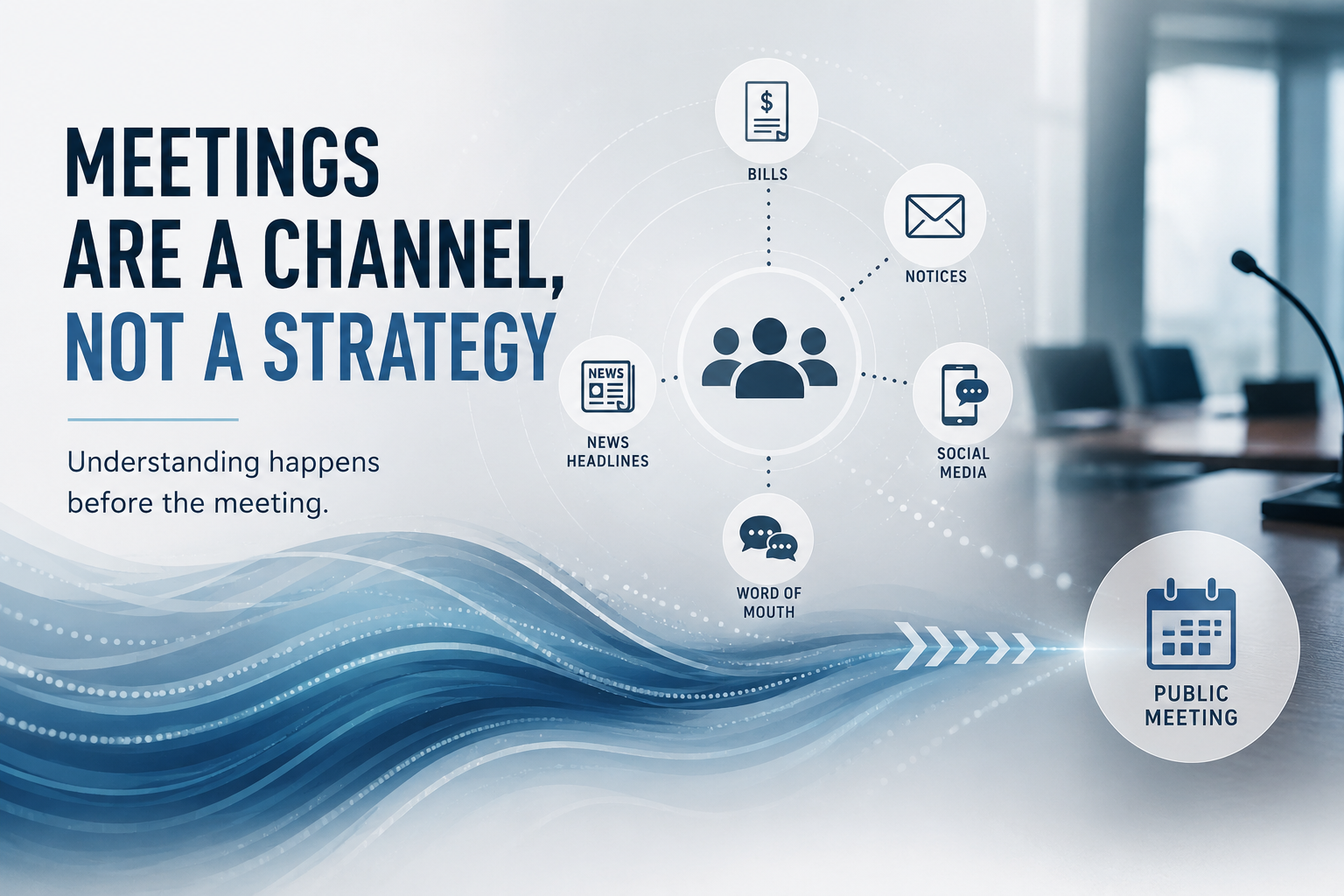
A disruption. A bill. A headline. A question asked under pressure.
Those moments are where the public decides whether your department is competent, prepared, and worthy of authority. In those moments, trust does not erode because you lack activity. Trust erodes when the department cannot explain itself clearly during disruptions.
If your leadership team cannot explain your department’s purpose in
30 seconds, you do not have a messaging problem. You have a risk problem.
Why 30 seconds matter
Directors do not get long runways when scrutiny hits. Staff are pulled into briefings, media inquiries, legislative questions, and community meetings. Information moves faster than approvals. People form conclusions before the next internal meeting starts.
In that environment, the department that speaks plainly earns the space to lead. The department that cannot speak plainly gets defined by others.
That definition becomes the story. The story becomes the operating environment.
The mission statement test
Most departments have a mission statement. Many of them read like they were designed to avoid disagreement rather than drive decisions.
Here is the difference between what is common and what is usable.
Common version
We are committed to serving the public by ensuring equitable access to high-quality services and promoting collaboration, accountability, and continuous improvement across programs and stakeholders.
It sounds responsible. It is also hard to repeat, hard to defend, and easy to ignore.
Usable version
We keep residents safe and services running by preventing problems, responding fast when they happen, and making recovery measurable.
A usable statement does three things.
- It says what you protect.
- It says what you do.
- It gives a listener a way to judge performance.
A usable statement is not a slogan. It is an operational tool. It gives staff a shared frame under pressure. It gives leaders a simple narrative that can survive hearings, headlines, and hard questions.
Clarity is a leadership control, not a branding exercise
When disruption hits, three groups look for the same thing.
- Internal teams want direction.
- Elected leaders want assurance.
- The public wants proof you are in control.
If your department cannot quickly explain its role, priorities, and measures of success, each group fills the gap with its own assumptions. That is where rumor grows, morale drops, and external confidence weakens.
Clarity reduces the number of interpretations in play. It speeds alignment. It protects credibility. It also helps you make decisions. When a new demand arises, the clearest departments can respond quickly.
- Does this support our purpose?
- Does it reduce the risks we own?
- Does it improve the outcomes we promised?
The pressure test directors should run
Do not wait for the next crisis to discover your team cannot explain the work. Pressure test now.
- Ask supervisors to explain the department’s role without notes.
- Ask program leads to describe what success looks like in one sentence.
- Ask frontline managers what the public should expect from your department in a disruption.
- Ask your communications lead to write a 30-second answer to the toughest question you do not want to get.
- Ask your deputy to give the same answer in a different room with different staff and see if it still matches.
Listen for the same failure patterns.
- Explanations that start with process instead of purpose.
- Language that sounds like internal policy instead of public service.
- A list of activities with no outcome.
- Statements that nobody can repeat twice in the same way.
If your answers vary widely, your department is carrying avoidable risk. Confusion does not stay internal. It shows up in response time, in inconsistent decisions, and in public messaging when pressure spikes.
What to do next
You do not need a long rebrand effort. You need a small set of clear statements that staff can use in real time.
Start with three elements.
- Your purpose in plain language.
- Your top three priorities when conditions change.
- Your measures show you are performing.
Then build discipline around repetition. The goal is not creativity. The goal is consistency under stress.
Because the next disruption will not wait for your department to find the right words. The first clear story that lands will shape what comes next.
If you cannot explain it in 30 seconds, your department has a risk.
Ready to pressure test your department’s 30-second explanation?
If you want an outside read before the next disruption forces the issue, book a 60-minute strategy session. We will review your current marketing or communication efforts, isolate where your story breaks under scrutiny, and leave you with clear, actionable steps your team can use right away.
This is a paid session. The fee is $150. Your consultant holds the Professional Certified Marketer designation from the American Marketing Association.
Click the button below for more information.